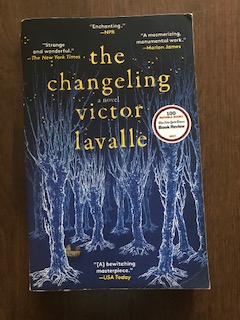
The Changeling

Rating: 5/5 Rare Books

Rare-bookseller Apollo Kagwa wanted to be the father he didn’t have. But a horrific act of violence against his son leads Apollo to discover a fantasy world hidden in New York City, full of the evil that feeds our nightmares. Victor LaValle’s The Changeling is a haunting, mesmerizing modern-day fairy tale that will stick with readers long after they’ve finished the book.

The Changeling follows Apollo’s journey into fatherhood. His own father disappeared when Apollo was young. Emma, Apollo’s wife, seems to have some signs of postpartum depression. Emma does something truly terrifying to the baby and vanishes. Much of the book focuses on Apollo’s journey to find his wife and baby and get some answers as to why Emma did what she did.

The Changeling is equal parts horror novel and fairy tale, with a dash of Chicken Soup for the Soul. Through Apollo’s quest, LaValle explores the complex themes of parenthood, racism, and love. It has a macabre backdrop, but The Changeling is fundamentally about how far parents will go out of love for their child.

LaValle expertly describes a fantasy world hiding in plain sight in New York City. His phenomenal, skilled world building is just one of the many reasons this book is perfection. Though the book takes place in modern-day New York City, something about it feels like a fairy tale that you, your parents, your grandparents, and their grandparents grew up hearing. It’s a universal and timeless tale that’s part of our DNA. LaValle is a skilled storyteller, and he writes The Changeling in a way that will make you feel like this is a familiar story from your childhood that you forgot, and reading it will feel like a lifelong itch has finally been scratched.

LaValle’s juxtaposition of fairy tale tropes with mundane daily things, like putting boxes in a car, makes The Changeling feel more realistic and, therefore, creepier. He has a way of writing vividly, and certain parts were so gross they’ll make your skin crawl. The way he described a warm room with all the radiators on made me feel toasty (despite being on a tundra-cool airplane).

The Changeling is a joy to read, and LaValle’s writing style makes it a page-turner. The dialog flows so naturally that reading it feels like overhearing a conversation. The writing seems effortless, and every single word has a purpose. LaValle shows readers what characters are like and what their motivations are; he never tells. It’s this masterful storytelling that makes The Changeling feel more like hearing a scary story from a relative than reading a book written by a stranger.

If you liked The Changeling, check out LaValle’s other work, including The Devil in Silver and The Ballad of Black Tom.
Moonlight Becomes You

Rating: 4/5 silver bullets

Moonlight Becomes You, the second novel in the Eidola Project series by Robert Herold, tells the story of a group of paranormal investigators who travel to Petersburg, Virginia, to determine what’s causing the brutal murders of Black people in the town. (Local law enforcement isn’t particularly interested in investigating as white people haven’t been affected much.) It is a captivating and gripping read full of suspense, action, and, of course, horror.

Moonlight Becomes You takes place in a town plagued by the KKK. The Eidola Project (the group of investigators) determines there may be a werewolf (or werewolves) terrorizing the town. (Come on; this isn’t a spoiler. There’s a werewolf on the cover of the book.) Herold creates an interesting juxtaposition between the horror and violence caused by the KKK and the horror and violence caused by the werewolf.

What’s most compelling about this book is the depth and complexity of characters. Nigel, a white man who fought for the South during the Civil War, struggles to relate to Eidola Project team member Edgar, a Black man, and Edgar struggles to deal with the racism he experiences from Nigel and society at large. This book provides readers with a creepy and compelling backstory on Nigel and his “gifts,” and we also see a lot of depth and growth from Nigel.

Herold’s phenomenal use of vivid imagery often causes a visceral reaction. He describes a werewolf transforming as including “an audible cracking of bones and cartilage.” He describes a corpse as “difficult to recognize as a person, except for the remnants of clothing and the hair still clinging to the back of a crushed skull…Nigel could see the halves of the rib cage spread wide to reveal the empty cavity of his chest.” Much of the creepiness of this book comes from Herold’s use of descriptive language that paints a gory and disturbing picture.

As noted earlier, this is the second book in a series. I’d highly recommend reading the first book, The Eidola Project, before you read this. The Eidola Project sets up how this investigative group got together and what their individual skills are. A lot of complex character development takes places in Moonlight Becomes You, but without reading the first book in the series, some of this character development may lack context.

One of the best things about this book is that, though it was episodic in terms of being about this group finding a werewolf, Herold has set up some broader themes and topics that I hope we’ll see in upcoming books. Nigel (to me at least) was a piece of crap in the first book, but now that I know how complicated and messy his backstory is, I sympathize with him, and I want to know what will happen to him in the future. The character development and powerful imagery make Moonlight Becomes You a must-read book for anyone interested in a classic monster story.

I need to warn you that though the werewolf plot is resolved at the end of the book, there’s a little bit of a cliffhanger. If you read this book, you’ll be desperate to read the next in the series. (I audibly gasped at the end of the book. I’m eagerly awaiting the next in the series!)

Disclaimer: I received a complimentary ebook copy of Moonlight Becomes You from the author. All opinions are my own and independent of receiving a free copy.

The Stand

Rating: 3/5 Payday wrappers

The Stand by Stephen King is a classic good-vs.-evil story, set during and immediately following a highly contagious and lethal flu kills most of the population. The beginning of the book follows how the flu spreads. Perhaps it has to do with living in a pandemic, but reading about this flu spreading was incredibly creepy. It hit close to home, and King perfectly captured the anxiety and fear felt in the early days of the pandemic. (Which still isn’t over! Wear a mask!) Fortunately for us, COVID is much less deadly than the flu imagined by King.

In The Stand, some people are immune to the flu, and these survivors have odd dreams. They dream of a kind older woman named Mother Abagail, who seems safe, caring, and warm. But they also dream of a more nefarious presence: Randall Flagg, AKA the dark man. The survivors know that these dreams are not mere dreams; they’re messages. They can join Mother Abagail or Randall Flagg in the post-flu United States. 

Mother Abagail’s love and peace draws some survivors in, while Randall’s use of violence and fear pulls others. The Stand asks if in a world completely reimagined, do good and evil still exist? Will good triumph over evil, or will people always choose their survival over their morals? 

The Stand would have been rated higher had it been shorter. My copy was just over 1,100 pages. The first 700 pages or so are a lot of exposition and background on all of the survivors. Some action happens, but it’s akin to the beginning of a meeting when you’re doing an extravagant icebreaker activity and you just want it to be over so you can discuss budgets or whatever. While it’s necessary to know the characters’ backstory and motivations, there was no need to spend so much time on exposition. (I honestly didn’t enjoy the first 700 pages, but then it got good.) 

Typically, King rightfully doesn’t get credit for the way he writes people of color and women. This book was originally published in 1978. We can say that times have changed and that people are more aware of racial microaggressions while still acknowledging that elements of this book don’t hold up well. King writes obsessively about one character’s “odd Chinese eyes.” That’s a direct quote. And he mentions that character’s odd Chinese eyes multiple times. (No, I’m not being too sensitive. I read this around the time that multiple innocent Asian people in Atlanta were murdered. Microaggressions are symptoms of a deeper, systemic issue. Not calling out this tomfoolery would make me part of the problem.) 

Overall, The Stand is an interesting story about good vs. evil, and a super-flu kicking off the events leading to the ultimate stand between good and evil makes for a fascinating backdrop. King does a phenomenal job tying together the stories of seemingly unconnected people. Had The Stand been shorter or gotten to the big showdown between good forces and evil forces sooner, I’d highly recommend it.

The Route of Ice and Salt

Rating: 4/5 boxes of dirt

“Anyone could be considered a monster. And monsters were assassinated with impunity.” –The Route of Ice and Salt

The Route of Ice and Salt by José Luis Zárate (and translated from Spanish into English by David Bowles) is a poetic and haunting novella about the story of a sea captain struggling with his closeted homosexuality, told through the events of Dracula’s transport to England. The captain is leading a small crew on the Demeter charged with delivering mysterious boxes of dirt. The captain is battling with his homosexuality, but his thoughts quickly turn to something that seems off on the Demeter. The schooner’s rats act oddly, and soon, crewmembers disappear. What’s happening on the Demeter, and can the captain stop it before it’s too late?

The Route of Ice and Salt is a fantastic story. Zárate builds suspense flawlessly, and despite how creepy and scary the novella is, it isn’t too graphic. He manages to combine poetic language and horror to create a work that is terribly beautiful (or beautifully terrible?).

Consider this quote: “Without hesitation, he chose the black face of the drowned, a mouth unhinged by despair, hands that tear bloody grooves in a throat closed forever by the sea.” Perhaps it’s because the original text was written in Spanish, but having the adjectives come after the nouns makes the impact that much scarier. Rather than imagining an unhinged mouth, readers picture a mouth that is then unhinged, making the reader’s mind commit the violence. (If your Spanish is good enough, you may want to try reading the original novella in Spanish. If I were capable of doing more in Spanish than talking about my weekend and asking how much things cost, I would absolutely read it.)

Bowles’ beautiful translation of the novella took diligence and care, as every word is purposeful and the vivid imagery was clearly retained from Zárate’s original work. Though this is a novella, much of it is poetic, and it may not be the quickest read; expect to reread certain elements multiple times to understand the true meaning of the text.

The Route of Ice and Salt is a haunting tale about our pasts, hunger, and if we can escape who we truly are. Bowles’ translation of The Route of Ice and Salt is one not to be missed by Dracula fans or anyone craving beautifully written horror.

Disclaimer: I received a complimentary ebook copy of The Route of Ice and Salt from Netgalley.

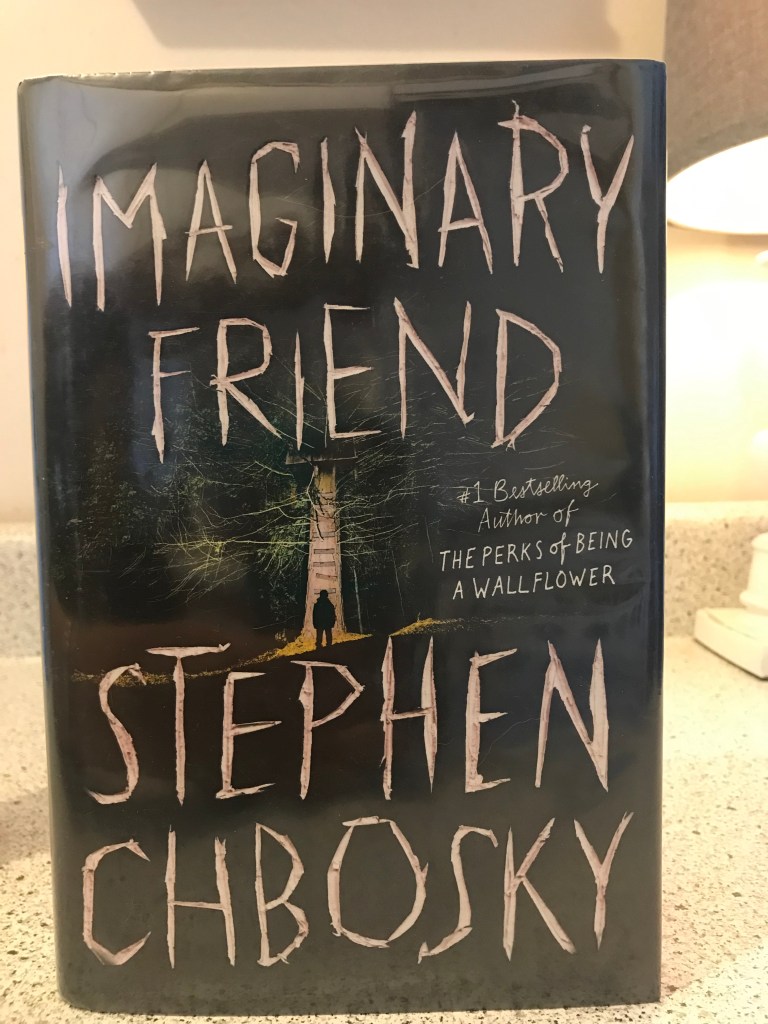
Imaginary Friend

2/5 plastic bags

The fight between good and evil, light and dark, and angels and demons is a universal tale and has served as the foundation for millions of stories. It is this struggle that serves as the primary conflict in Imaginary Friend by Stephen Chbosky.

Imaginary Friend tells the story of 7-year-old Christopher, a boy whose mother moves him to Pennsylvania to escape her abusive partner. Christopher struggles with school, but he’s a sweet kid. He disappears into a forest and vanishes for six days. When he comes out, he suddenly aces all of his tests, and he just knows things about the people around him. And the mysterious, possibly imaginary, nice man who helped him in the forest is nowhere to be found.

The nice man stays in touch with Christopher. And to defeat a strong, powerful, evil force, Christopher has to build a tree house in the middle of the forest in which he disappeared, otherwise terrible things will happen to everyone in town. The tree house is a portal to an imaginary world, which looks like the regular world, but for his own safety, Christopher can’t go there at night and can’t go there without the nice man.

The beginning of this book, while a bit slow paced, tells a compelling story. One of the most complex and interesting characters is Ambrose, an older man who is grappling with guilt over his role in the disappearance of his little brother, nearly 50 years ago. It would’ve been really interesting to focus more on Ambrose and possibly even tell the story from his point of view.

One of the biggest challenges in reading Imaginary Friend is the writing style. In the last third of the book, big chunks of dialog and some exposition iS wRitteN likE thiS, which is incredibly distracting and makes me think of this SpongeBob meme. (Also, people don’t speak in capital letters, unless they’re being used to emphasize pronunciation.) I initially thought maybe this was some kind of secret message, but then I read about 6 e’s in a row and realized it was just a creative choice.

Another challenge with this book is the lack of subtlety. For example, the number 217 comes up a lot (possibly in homage to my favorite book, The Shining). I mean it comes up a lot. Trust the reader! We are smart, and subtlety is appreciated! In fact, references are more meaningful when it takes a while for them to sink in. Furthermore, it’s bold to reference one of the greatest horror novels of all time so much. It distracted me from Imaginary Friend and just made me wish I were reading The Shining instead. (They’re approximately the same length. If you have time to read ~700 pages of a book, pick up The Shining.)

Mild spoiler alert: This book did not need to be nearly as long as it was, and all of the buildup was not worth it. If you have trouble with dairy, take a Lactaid before reading this, because the ending is cheesy. Forgiveness is effortless, and generational trauma ends in just one night. Imaginary Friend lacks the depth and nuanced understanding of some of the topics addressed in the book, such as domestic violence and child abuse.

And as nice as it can be to go into a book with no expectations or no ideas of what’s going to happen, it’s important to know the book’s genre and for publishers to market their books accordingly. Imaginary Friend should have been upfront about the overall Biblical theme. Readers should know what they’re getting into before picking up a 700-page novel. And as with The Shining allusions, the Biblical allusions are not subtle. That said, I’m not even sure a Christian audience would love Imaginary Friend, as there’s a bunch of swearing and some content that may be offensive to people who want to read Christian horror. (Side note: Is Christian horror a thing? I think it absolutely should be.)

Imaginary Friend touched on complex and difficult topics and had potential to be a classic story of good vs. evil and if those forces are as oppositional as we think, but the lack of nuance and jarring writing style limited its potential.

If you are looking for an interesting story that blurs the line between good and evil, check out The Hunger.

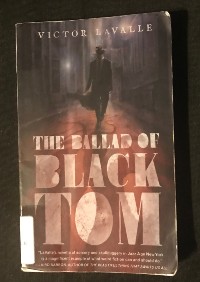
The Ballad of Black Tom

Rating: 4.5/5 guitars

The Ballad of Black Tom by Victor LaValle is an amazing and poignant novella, telling the story of Charles Thomas Tester, a young Black man in Harlem. He works hard to provide for himself and his dad, and a routine job to deliver an odd book to a woman Flushing Meadows starts the adventure of a lifetime. Tom plays guitar and sings (pretty poorly), and he draws the attention of a man named Robert Suydam who wants Tom to play for a party he’s having. Before he knows it, Tom is drawn deep into the world of magic and the occult

This novella is based on the H. P. Lovecraft short story “The Horror at Red Hook.” (Disclaimer: I haven’t read Lovecraft because of the racism. I get that a lot of modern horror authors draw from his body of work, but I’d rather spend my limited time reading books by BIPOC authors and just skimming Lovecraft’s Wikipedia pages.) It is told through the perspective of a Black man in the 1920s and the struggles Tom faces as a result of racism and police brutality. As he did in The Devil in Silver, LaValle discusses social issues in a horror setting. Readers see the police actively harm Tom and explore the ramifications of structural racism. And what’s especially haunting is that the horrors Tom experiences in the 1920s are the many of the same horrors Black people in America face today. LaValle is a master at telling very real human stories in a scary, supernatrual context, and he illustrates that real life may be more disturbing than the creepy tales told around campfires.

The Ballad of Black Tom is a truly phenomenal novella, and anyone who likes Lovecraft would love this piece. Shorter stories sometimes struggle to sufficiently develop characters, but LaValle is such a skilled writer that readers get to know Tom quickly. It absolutely has its moments of pure, creepy, terror, but it might also break your heart.

The Year of the Witching

5/5 Mysterious Journals

The Year of the Witching by Alexis Henderson is the feminist supernatural story we all need and deserve right now. It tells the story of Immannuelle Moore, a young woman living in Bethel, a town run by the church. But it’s no ordinary church; there is a Prophet who is in charge of the whole town, polygamy is very much a thing, and there are some pretty gross routine rituals. But the church protects people from the evil of the Darkwood, a forest by Bethel. It is said that the first Prophet killed four witches who lived in the forest and meant the townspeople harm.

Immanuelle was conceived out of wedlock. (And her father was another race, so you can imagine the pearl clutching her parents’ relationship caused.) Her mother disappeared into the Darkwood while pregnant with Immanuelle but eventually came back to Bethel. She passed away, so Immanuelle’s (maternal) grandparents raised her.

Immanuelle follows the rules of the church, but she sometimes finds herself drawn to the Darkwood. Could it be because of her mom’s time spent there? She one day succumbs to the temptation of the Darkwood and finds one of her mom’s journals. This journal leaves Immanuelle wondering why her mother trusted the witches. But it also provides a warning of the terrors coming to Bethel.

The Year of the Witching has many dichotomies that lead Immanuelle to reevaluate everything she knew. Bethel and the church are described as good, while the forest is evil; the church is light, but the witches are dark; the Prophet (obviously a man) is in direct opposition to the witches (women). After seeing some of the evils of the church (the Prophet specifically), Immanuelle grapples with the idea of good and evil. Are the lessons of her childhood true? Are good and evil always opposing forces, or is the line between them blurred? Can those revered as good have some evil in them?

For much of the book, Immanuelle has to evaluate the forces within herself. Does her mother’s relationship with the witches mean Immanuelle is destined to a life of evil and destruction? How much do her parents and their pasts define her, and how much agency does she really have?

The Year of the Witching is an empowering, enthralling story. It’s a story about revolution, fighting evil, and recognizing (and potentially dismantling) oppressive structures. Henderson wrote an amazing story: It has heart, horror, and (most importantly) hope. Now stop reading this review and go buy it from your favorite Black-owned bookstore. You won’t be able to put this book down.

Disclaimer: I received this complimentary ebook from Netgalley.

The Hunger

Rating: 4.5/5 broken wagon wheels

Alma Katsu’s The Hunger is a horrifying retelling of the tragic events surrounding the Donner Party. (If you don’t know about the Donner Party, don’t Google it before reading The Hunger, but definitely read up on it. It’s tragic and heartbreaking.) In The Hunger, a group called the Donner Party goes West in search of new opportunities and escape from their pasts, but the trip there is grueling and taxing.

There’s definitely something evil following the Donner Party, but the party doesn’t know what it is. Is it someone evil who’s part of the group? Are the mysterious pasts of the travelers catching up with them? Are they being followed by wolves? Whatever it is, it’s getting closer, and the group is becoming smaller and smaller, and each passing day reduces their food supply and brings them closer to what seems like unavoidable death.

The Hunger is, without a doubt, full of horror. Katsu knows how to build suspense, and when describing terrifying events, she brilliantly paints a vivid picture for readers, but she does so with a respectful sensitivity.

On the note of sensitivity, this book deals with indigenous peoples and many of the racist stereotypes against them, especially those held by early settlers. (You may remember that I called a reliance on these tropes boring and tired in a previous review.) But Katsu approaches this topic with kindness and care. In fact, her acknowledgements state that she didn’t want to glaze over the harmful views of native peoples but also didn’t want to perpetuate those stereotypes. It’s this sensitivity and awareness that sets Katsu’s work apart from others that rely on this trope just for funsies.

The Hunger touches on complex themes like moral relativity and the extents people will go to just to survive. Do the notions of good that apply during prosperity also apply during a time of starvation and death? Do social norms need to be upheld if it’s a matter of life and death? What are your limits when it comes to keeping yourself and your family alive?

In addition to those questions, The Hunger questions the notion of good or evil. The Hunger is told through the perspective of different characters, so readers get everyone’s backstory. A character we are lead to believe is evil has a complex background, so does that excuse his actions? What if someone does evil things for a good reason? Is that person good or evil? (Or are dichotomies like good and evil silly oversimplifications?)

Classifying The Hunger a horror novel does it a disservice; it’s so much more. It beautifully tells the stories of the variety of feelings humans have, from hunger to betrayal to sadness to love. It forces readers to think of good, evil, survival, and love. It reminds us that though some parts of life are horrific, other parts are full of beauty, and you can’t have one without the other.

Baby Teeth

Rating: 3/5 creepy children

Baby Teeth by Zoje Stage tells the story of troubled Hanna Jensen, the only child of her parents, Suzette and Alex. Despite being seven, Hanna has yet to speak, and she does not attend school. (She has been to school but was kicked out. It turns out that setting garbage cans on fire isn’t OK. Now you know.) Hanna’s behavior and lack of speech concerns her mother, but Alex seems to think there’s nothing to worry about.

Rather than being relieved, Suzette is terrified when Hanna utters her first words. She speaks in a French accent and insists she is Marie-Anne Dufosset, a French witch who was burned at the stake. And Hanna’s (or Marie-Anne’s) first words to Suzette are disturbing. Is Hanna possessed? Or is it even more sinister? Is she faking possession to scare Suzette?

The book alternates between Suzette’s perspective and Hanna’s perspective. Hanna hates her mommy (she’s 7; she still thinks of her mom as “mommy,” and there’s something incredibly disturbing about her talking about how much she wants to hurt mommy), but loves her daddy. Daddy is perfect in Hanna’s mind. Suzette’s sections explore her frustration with Hanna’s behavior, her exhaustion due to being a stay-at-home mom who never gets a break from Hanna, and the pain she’s experienced as a result of her Crohn’s. (The Crohn’s took up a lot of real estate in the book, but didn’t have much of a payoff in the end.)

Suzette spends much of the book trying to get her husband to see Hanna’s troubling behavior. Hanna/Marie-Anne doesn’t seem to speak to Alex. Alex is insufferable. Alex works all day, so Suzette does much of the parenting and disciplining, which may be part of why Hanna loves daddy but hates mommy. Alex is blind to Suzette’s fatigue and refuses to see any faults in his precious daughter.

Hanna’s behavior is highly disturbing, and it quickly turns physical. Stage does an incredible job building up to these outbursts, but after the climax, the scene fizzles out. The denouement of each outburst leaves something to be desired. It feels as though Hanna lashes out violently and then quickly calms down and all her anger immediately subsides, which leaves the most disturbing parts of this book to fall flat.

In my (young, childfree person’s) opinion, the most disturbing element of this book isn’t Hanna’s behavior; it’s parenting. A wrench is thrown into Suzette and Alex’s marriage once Hanna is born. Their lives are made substantially more difficult with Hanna’s arrival, even before she begins to exhibit her disturbing behavior. But they had her and they can’t take back the decision to be parents. Suzette ends up with a disproportionate share of the work and struggle, and her (allegedly) loving husband doesn’t see or doesn’t want to see her challenges. (Sorry I called him allegedly loving. But I really can’t stand him. He just reminds me of every man who doubts everything a woman says.)

While I wouldn’t say that this book will scare the crap out of you, it has some disturbing elements. And Stage is an incredible storyteller. (Seriously, one part where Suzette described her Crohn’s almost made me puke.) The alternating perspectives help readers get into the minds of the opposing forces. (Even though Alex was the real villain. OK, I’ll stop.)

If you are interested in stories about disturbing kids, sociopaths and psychopaths, you may enjoy Baby Teeth.

Notes on the Audiobook

I love audiobooks, but I admit that some of the language and author’s rhetorical devices can get lost when I’m listening to a book during my infuriating commute. But Gabra Zackman, narrator of the audiobook, is a phenomenal voice actor. I think the creepy voice she used for Hanna made Hanna’s character more disturbing than if I had read the book in print or e-book. I highly recommend the audiobook of Baby Teeth.

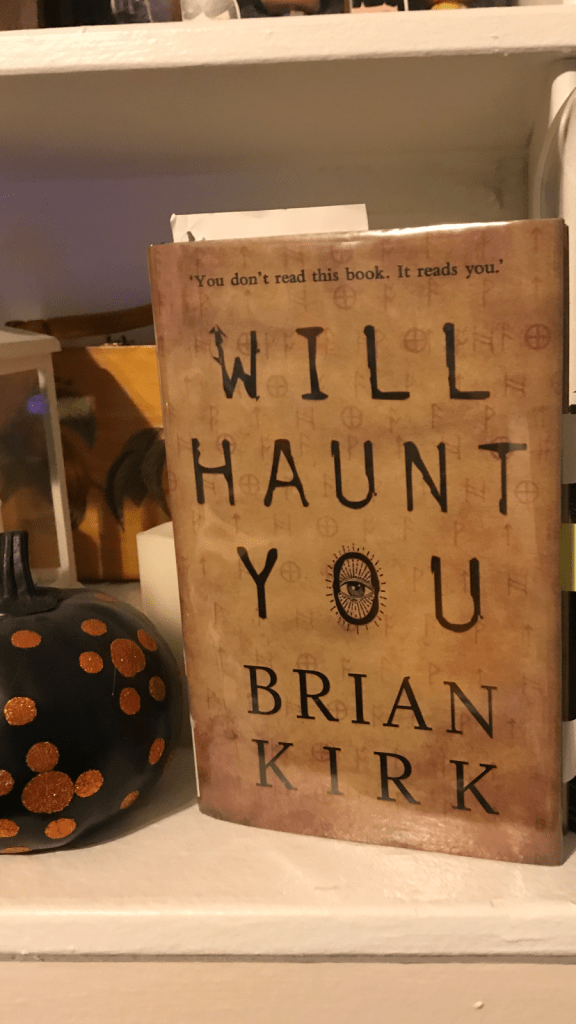
Will Haunt You

Rating: 3/5 creepy books

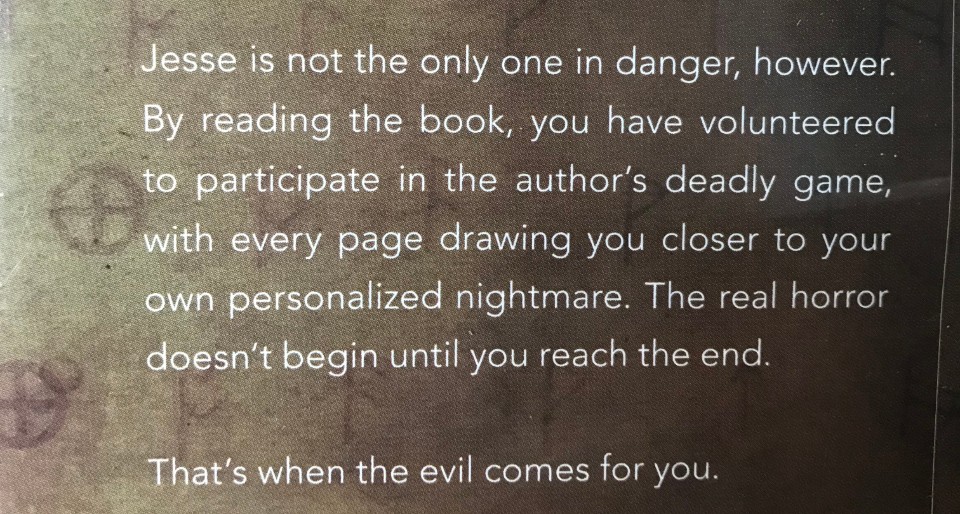
You know how in a lot of horror movies, there’s the one skeptic who doesn’t believe in the supernatural, so they taunt it, only to be the one killed in the most gruesome way? The Will Haunt You book jacket makes readers not want to tempt this potentially supernatural book. (See photo.)

Will Haunt You tells the story of former musician Jesse Wheeler. Years ago, Jesse came home drunk after a gig, and his son suffered a serious, life-altering injury while Jesse should have been watching him. That event was a wake-up call, and Jesse has been sober for years.

Jesse performs with his band after a long hiatus and manages to stay sober, despite pressure from his bandmates. He acts as designated driver for one of his bandmates, but what should have been an ordinary drive became something much more sinister.

A weird radio station he’s listening to on the drive seems to know exactly what Jesse is up to, and the car clock is stuck on midnight for what feels like ages. His car stalls and two cops appear. But something feels off…it quickly becomes clear that the cops are not there to help.

This begins Jesse’s haunting. He ends up in what initially looks like a hospital but is quickly revealed to be his own unique personal hell. He is forced to confront his demons, and just when he thinks things cannot get worse, they do. Someone knows his secrets and is using them to terrify him.

All of this is happening to Jesse because he read Will Haunt You, and anyone who reads the book becomes a part of the book’s sinister plans. Brian Kirk tells Jesse’s story of being tortured and manipulated by evil masterminds, and Kirk warns the reader that a similar fate awaits us if we continue reading. At the beginning of the book, Kirk effectively creeps out the reader by telling us that we’re next and there’s no way out.

But it’s Kirk’s promises that we’d be haunted that led the book to fall flat. The scariest element of the book is that we are next, but much of the book didn’t reference that. It’s a risky choice to break the fourth wall, but if an author’s going to do it, it needs to really draw the reader in and make an essential element of the book. It felt like it was randomly peppered in throughout the book to scare readers. The book focused mostly on what was happening to Jesse, and it felt like the fourth wall broke when Jesse’s torture got a little mundane.

Kirk does a fantastic job building suspense, but often, nothing happens with that feeling. After something bad happened, Jesse would allude to things getting much worse than they just were, which is a fantastic way to pique readers’ interest, but the worse thing was often a letdown, and I found myself left with excitement that had nowhere to go.

While this book definitely has elements that are creepy, more needed to be done to pull the reader in and make the book more immersive. The reader involvement needs to feel more engrained within the book rather than being used as a crutch to make the book feel scarier.