The Eidola Project

Rating: 4/5 Ghostbusters

I find mediums and fortunetellers fascinating. I think a lot of them are frauds (“Does anyone here know someone who died from something involving a sickness?”), but a few have me convinced that there are some people with a paranormal gift. (Like Seema Bal from The Real Housewives of New York has to be the real deal, right?) So I was thrilled to see The Eidola Project by Robert Herold explored fraud within the paranormal and didn’t force the reader to accept all paranormal activities as truth.

The Eidola Project tells the story of a paranormal investigation group in the late 1800s. This group debunks frauds and tries to learn more about the few real deals who they encounter.

Much of the book tells the story of Sarah Bradbury, a young woman who, early in the book, is able to find a missing woman using paranormal skills. These skills lead to her being sold to a traveling circus, but she escapes that to join the Eidola Project. Soon after, she has dreams that drive her to find a stranger named Nigel Pickford, who quickly becomes part of the group.

The group is called to Nantucket Island to investigate some odd happenings. They are assisting a woman named Lenore Hutchinson, who has a pesky ghost problem. Almost immediately, the Eidola Project knows something sinister is going on in the house. But is it as simple as the presence of ghosts? Or is it a more complex villain?

The Eidola Project has some truly creepy and suspenseful moments, but much of the action happens at the end.

The Eidola Project spends a good deal of time developing Sarah Bradbury’s character. But Nigel Pickford is an interesting (and equally important) character, and it would have been nice to get more of a backstory on him.

The last third to quarter of the book is the best part; it has a lot of creepy things happen, and the earlier seemingly unrelated chapters come together. The chapters go from location to location, and the Nantucket Island chapters are scary and disturbing, and it would have been great if the other chapters also had this.

Overall, The Eidola Project is a great quick read for anyone craving a ghost story.

On a minor note, the author’s note at the end rebranded the book group as a literary coven, and that’s my favorite new term. I refuse to join a book club unless it’s called a literary coven.

Disclaimer: I received a complimentary ebook copy of The Eidola Project from Netgalley.

Nos4a2

3.5/5 Scrabble Tiles

Nos4a2’s Vic McQueen has a very special bike. When she rides it through a rickety old tunnel, it takes her to anywhere she wants to go. She’s been able to use her bike to find things that her parent’s have misplaced. The process of traveling on her bike is exhausting though, and it takes a lot for her to keep her bike’s powers a secret.

One day, she rides her bike through the tunnel and finds something that will change the course of her life. She encounters Charles Talent Manx, a child abductor. She narrowly escapes his clutches, but the experience haunts her for the rest of her life. She receives eerie phone calls from Charles’ victims throughout her life, and no matter what extreme measures she goes to, the calls just won’t stop.

The only other person who she knows of who has experienced power similar to the bike’s is a woman named Maggie, but Maggie has magical Scrabble tiles.

Years later, Charles (who is eventually arrested and convicted of child abduction) dies…or does he? Vic swears that he has made a reappearance in her life, but why should she be believed? Charles is dead. And the dead don’t come back to life…right?

Despite Charles being a kidnapper and possibly a vampire, he isn’t the scariest character in the book. That role belongs to Bing Partridge, Charles’ right-hand man. Bing has the mental capacities of a child, but the gross and disturbing desires of a creepy adult. He uses sevoflurane, a gas that smells like gingerbread, to subdue Charles’ victims. The gingerbread smell is fitting, as Charles says he takes his victims to Christmasland, a magical place that’s definitely not creepy in any way.

Author Joe Hill’s descriptive language and disturbing imagery in the earlier parts of the book make it truly terrifying. Specifically, Charles kidnaps kids and then does something to their brains that makes them extremely chipper, which is somehow much more terrifying than if they tried to be creepy. (There’s one part where a creepy little kid repeatedly bashes his head against a glass door to try and break it, all with a smile on his face, and Hill’s vivid descriptions make it truly terrifying.) But many of those scares are earlier in the book, while the latter part of the book is more of a race-against-the-clock story and has very few scares. I think the book could’ve been shorter, only because I found myself constantly checking what percentage of the book I was at and how much time was left on the chapter. (I borrowed this ebook from the library and read it on my Kindle.)

Hill makes a lot of references to some horror favorites: Vic’s bike reminded me of Bill Denbrough and his bike, Charles has a car that reminded me of Christine, and Pennywise is explicitly mentioned in Nos4a2. While these references to his pop’s books are great, they felt like they were a distraction from the story Hill wanted to tell. (We don’t need to talk about how long it took for me to realize Joe Hill is Stephen King’s son.) Seeing Pennywise’s name just made me want to read It. These allusions take the reader out of the interesting story Hill was telling, and it forced my brain to compare Hill with his dad, which I don’t want to do! He is his own person and a talented author whose work should be evaluated independent of being the child of two popular novelists, but the allusions held him back.

Nos4a2 is such a unique take on the classic vampire story (something that’s truly hard to do), but the allusions and wordiness sometimes took away from an otherwise interesting, creepy, and compelling story.

The Institute

Rating: 3/5 shots for dots

Luke Ellis is an exceptionally smart kid, to the point that he’s only twelve but will soon enroll at MIT and Emerson. Luke is intelligent, but that’s not what catches the eye of the Institute, a seemingly under-the-radar, mysterious place in Maine. They’re interested in Luke’s basic telekinesis (TK) abilities (despite the fact that all Luke can really do is move an empty pizza pan; he’s no Carrie). In fact, the folks at the institute are so interested that they break into Luke’s home, murder his parents, and whisk Luke away.

Luke awakens in a room that looks eerily similar to his bedroom. Luke meets a girl, Kalisha, who explains that The Institute houses kids with telekinetic and telepathic (TP) powers. Luke and Kalisha are currently in Front Half, where the Institute staff conduct weird, painful experiments on them, and refusal to comply with staff requests often results in physical punishment.  Some of the torture areas have posters that say “Shots for Dots,” and the kids often receive shots for some unknown purpose. One staff member, Maureen, a housekeeper, seems nice, but most others seem to enjoy flexing their power over the children. Kalisha has been in Front Half for a while, but she has seen many kids who are no longer there.

At some point, kids move on to Back Half. What happens there remains a mystery. Staff say that after Back Half, the kids’ brains are wiped and they’re returned back home. (But come on…that seems unlikely.) Most of the kids in Front Half fear Back Half, despite not knowing what exactly happens there. Luke wants to escape The Institute before he has to find out exactly what happens at Back Half.

The painful Front Half experiments seem to be used to amplify TK and TP abilities. (Could it also be to see if people with TK can become TP? No, maybe that’s just one rogue doctor, conducting his own little side project.) It quickly becomes clear that the Institute wants to harness kids’ TK and TP abilities, but for what?

When King reveals why the Institute is taking control of kids’ TK and TP abilities, it raises an interesting moral question: Is the “good” the kids are doing worth the pain and abuse to which they’re subjected? Much of the book grapples with this question and makes the reader wonder if this were actually happening, would it be ok? How can good or evil be quantified? Is strict utilitarianism an effective, ethical, and humane way to guide conduct?

The Institute is a good book, and if it were written by anyone else, it may have been 3.5 shots for dots instead of 3, but I hold Stephen King to a higher standard. I’m not sure if that’s fair, but the man wrote The Shining! He wrote IT! He wrote Pet Sematary! I expect a King book to freak me out and/or strike an emotional cord, and The Institute didn’t. That said, it’s incredibly well written, as King’s books are. It’s an interesting story, but it won’t change your life, and it probably won’t be a book you reread.

Oops! An Explanation…

Have you ever had a dream that you find a library book in your home that was due 2 years ago, and instead of returning it, you put it in a closet and pretend it isn’t there, but it mocks you, and you begin living your own horrifying tell-tale heart reality, hearing the pages faintly rustling through the closet door? That’s me with this blog right now.

If you are a regular reader of this blog (i.e., you’re my mother or a horror fan who somehow found my blog), you may be wondering where I’ve been. I could blame my absence on starting a new job, or the pandemic, or being busy teaching my cat how to high five. But the truth is, I was in a rut. I read two books (reviews coming soon) that were incredibly ~meh~ to write about. That’s not to say they were bad, but I didn’t have much to say about them, positive or negative. I’d sit down and struggle to find some emotion they evoked in me, but nothing happened.

Then it hit me: Not having a lot to say in a review speaks volumes about a book. I could talk for hours about why The Shining is so wonderful or why Pet Sematary is an amazing book but will always be a terrible film.

So with that said, the style of my reviews may be inconsistent moving forward. I may write 12 paragraphs in one review but only 2 in the next. I’ll point out when a book wasn’t remarkable, but you’ll probably be able to tell based on the length that it isn’t a book I felt any type of emotion toward.

So that’s my update! I hope y’all are in happy, healthy, and surrounded by good books!

Until next time,

-S

The Shining

Rating: 5/5 hedge animals

The Shining is one of those rare horror novels that is equal parts horror and heart. It tells the story of the Torrance family (Jack, Wendy, and their son, Danny) who are the winter caretakers of the Overlook Hotel. Some hard times have resulted in them having to spend a brutal Colorado winter pent up in this historic hotel. Jack, a recovering alcoholic, lost his teaching position because he lost his temper. This caretaker job pays well and seems like it’ll give Jack time to focus on his writing.

Five-year-old Danny has a special gift that the hotel’s cook calls “the shining,” which gives Danny the ability to just know things. He can pick up on where misplaced items are, and he often knows what people are thinking.

The Overlook Hotel has a scandalous history. Many murders took place there, but the owners always kept those stories out of the headlines. As the Torrance family spends more and more time in the hotel, Danny begins to notice some disturbing things about it. He can sometimes see the (literal) bloody history of the hotel, but when he blinks, it (sometimes) disappears.

As their time in the hotel grows, Jack’s behavior becomes increasingly disturbing. He has random thoughts about murdering his family, and he feels that he needs to protect the hotel from anyone who may do it harm. It seems as though the hotel is possessing him.

Stephen King is a master storyteller. (I’m explicitly stating that here in case anyone reading this needed a random stranger’s opinion on King. Now you know.) The pacing of The Shining is perfect, and King knows how to build suspense. A lot of the imagery is specific enough to be scary but vague enough that your imagination has to do a lot of the heavy lifting. (And if your brain is even half as creepy as mine, you’ll be terrified.) The last few chapters of the book will keep readers in suspense, and I think it’s physically impossible to put it down toward the end.

Throughout the book, readers see Jack descend into madness. And it’s this slow descent into madness that makes The Shining so powerful. King lets readers experience the inner turmoil Jack faces over his love for his family versus the power of the Overlook. And despite everything Jack does, Wendy and Danny still love him and never blame him for the hell he’s putting them through. (Wendy reminds Danny that it isn’t daddy who’s trying to kill them.)

On the surface The Shining may seem like a story about a creepy hotel, but it is so much more. It asks if the demons of our pasts can ever truly die. (Can Jack ever escape the pain he caused his family when he was an alcoholic? Can Wendy and Danny ever forget what he did to them?)

It also illustrates how challenging it can be to overcome generational trauma. While Jack’s descending into madness, he begins to empathize with his abusive, garbage-bag-of-a-human father. And he begins to see that, despite how differently he’s lived his life, he isn’t that different than his father. And one of Jack’s favorite insults for Wendy is that she’s just like her awful, distant mother. The Shining asks if we can ever stop reliving the nightmares of our ancestors, and if love can conquer the demons of our past.

This book receives 5/5 hedge animals because it epitomizes what a horror novel should be and because it has so much heart. It’s ultimately a story about love and family that just so happens to be relayed through one of the best horror stories ever told. If you haven’t read it, go to your local indie bookstore and buy The Shining immediately.

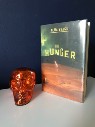
The Hunger

Rating: 4.5/5 broken wagon wheels

Alma Katsu’s The Hunger is a horrifying retelling of the tragic events surrounding the Donner Party. (If you don’t know about the Donner Party, don’t Google it before reading The Hunger, but definitely read up on it. It’s tragic and heartbreaking.) In The Hunger, a group called the Donner Party goes West in search of new opportunities and escape from their pasts, but the trip there is grueling and taxing.

There’s definitely something evil following the Donner Party, but the party doesn’t know what it is. Is it someone evil who’s part of the group? Are the mysterious pasts of the travelers catching up with them? Are they being followed by wolves? Whatever it is, it’s getting closer, and the group is becoming smaller and smaller, and each passing day reduces their food supply and brings them closer to what seems like unavoidable death.

The Hunger is, without a doubt, full of horror. Katsu knows how to build suspense, and when describing terrifying events, she brilliantly paints a vivid picture for readers, but she does so with a respectful sensitivity.

On the note of sensitivity, this book deals with indigenous peoples and many of the racist stereotypes against them, especially those held by early settlers. (You may remember that I called a reliance on these tropes boring and tired in a previous review.) But Katsu approaches this topic with kindness and care. In fact, her acknowledgements state that she didn’t want to glaze over the harmful views of native peoples but also didn’t want to perpetuate those stereotypes. It’s this sensitivity and awareness that sets Katsu’s work apart from others that rely on this trope just for funsies.

The Hunger touches on complex themes like moral relativity and the extents people will go to just to survive. Do the notions of good that apply during prosperity also apply during a time of starvation and death? Do social norms need to be upheld if it’s a matter of life and death? What are your limits when it comes to keeping yourself and your family alive?

In addition to those questions, The Hunger questions the notion of good or evil. The Hunger is told through the perspective of different characters, so readers get everyone’s backstory. A character we are lead to believe is evil has a complex background, so does that excuse his actions? What if someone does evil things for a good reason? Is that person good or evil? (Or are dichotomies like good and evil silly oversimplifications?)

Classifying The Hunger a horror novel does it a disservice; it’s so much more. It beautifully tells the stories of the variety of feelings humans have, from hunger to betrayal to sadness to love. It forces readers to think of good, evil, survival, and love. It reminds us that though some parts of life are horrific, other parts are full of beauty, and you can’t have one without the other.

Baby Teeth

Rating: 3/5 creepy children

Baby Teeth by Zoje Stage tells the story of troubled Hanna Jensen, the only child of her parents, Suzette and Alex. Despite being seven, Hanna has yet to speak, and she does not attend school. (She has been to school but was kicked out. It turns out that setting garbage cans on fire isn’t OK. Now you know.) Hanna’s behavior and lack of speech concerns her mother, but Alex seems to think there’s nothing to worry about.

Rather than being relieved, Suzette is terrified when Hanna utters her first words. She speaks in a French accent and insists she is Marie-Anne Dufosset, a French witch who was burned at the stake. And Hanna’s (or Marie-Anne’s) first words to Suzette are disturbing. Is Hanna possessed? Or is it even more sinister? Is she faking possession to scare Suzette?

The book alternates between Suzette’s perspective and Hanna’s perspective. Hanna hates her mommy (she’s 7; she still thinks of her mom as “mommy,” and there’s something incredibly disturbing about her talking about how much she wants to hurt mommy), but loves her daddy. Daddy is perfect in Hanna’s mind. Suzette’s sections explore her frustration with Hanna’s behavior, her exhaustion due to being a stay-at-home mom who never gets a break from Hanna, and the pain she’s experienced as a result of her Crohn’s. (The Crohn’s took up a lot of real estate in the book, but didn’t have much of a payoff in the end.)

Suzette spends much of the book trying to get her husband to see Hanna’s troubling behavior. Hanna/Marie-Anne doesn’t seem to speak to Alex. Alex is insufferable. Alex works all day, so Suzette does much of the parenting and disciplining, which may be part of why Hanna loves daddy but hates mommy. Alex is blind to Suzette’s fatigue and refuses to see any faults in his precious daughter.

Hanna’s behavior is highly disturbing, and it quickly turns physical. Stage does an incredible job building up to these outbursts, but after the climax, the scene fizzles out. The denouement of each outburst leaves something to be desired. It feels as though Hanna lashes out violently and then quickly calms down and all her anger immediately subsides, which leaves the most disturbing parts of this book to fall flat.

In my (young, childfree person’s) opinion, the most disturbing element of this book isn’t Hanna’s behavior; it’s parenting. A wrench is thrown into Suzette and Alex’s marriage once Hanna is born. Their lives are made substantially more difficult with Hanna’s arrival, even before she begins to exhibit her disturbing behavior. But they had her and they can’t take back the decision to be parents. Suzette ends up with a disproportionate share of the work and struggle, and her (allegedly) loving husband doesn’t see or doesn’t want to see her challenges. (Sorry I called him allegedly loving. But I really can’t stand him. He just reminds me of every man who doubts everything a woman says.)

While I wouldn’t say that this book will scare the crap out of you, it has some disturbing elements. And Stage is an incredible storyteller. (Seriously, one part where Suzette described her Crohn’s almost made me puke.) The alternating perspectives help readers get into the minds of the opposing forces. (Even though Alex was the real villain. OK, I’ll stop.)

If you are interested in stories about disturbing kids, sociopaths and psychopaths, you may enjoy Baby Teeth.

Notes on the Audiobook

I love audiobooks, but I admit that some of the language and author’s rhetorical devices can get lost when I’m listening to a book during my infuriating commute. But Gabra Zackman, narrator of the audiobook, is a phenomenal voice actor. I think the creepy voice she used for Hanna made Hanna’s character more disturbing than if I had read the book in print or e-book. I highly recommend the audiobook of Baby Teeth.

Will Haunt You

Rating: 3/5 creepy books

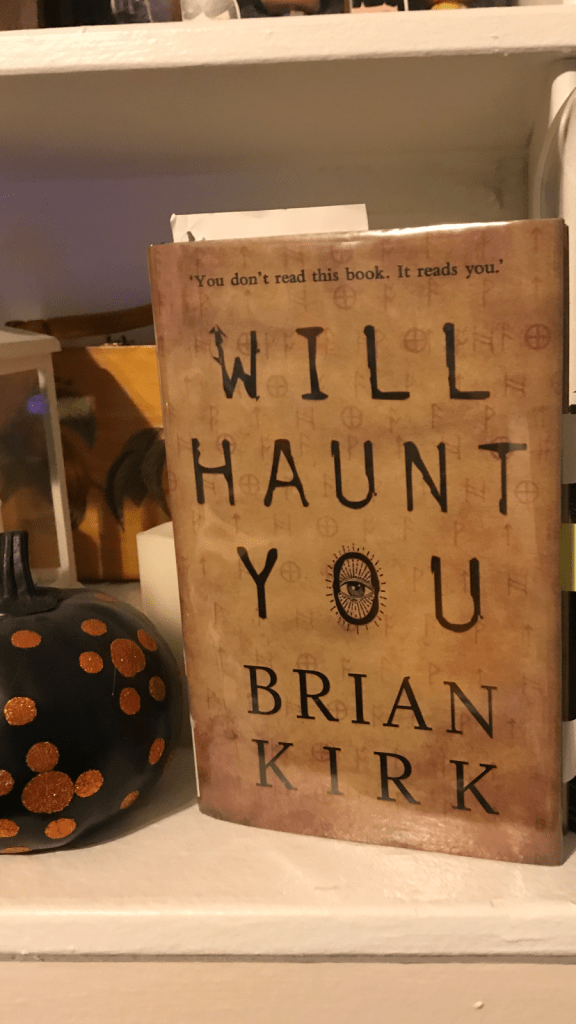
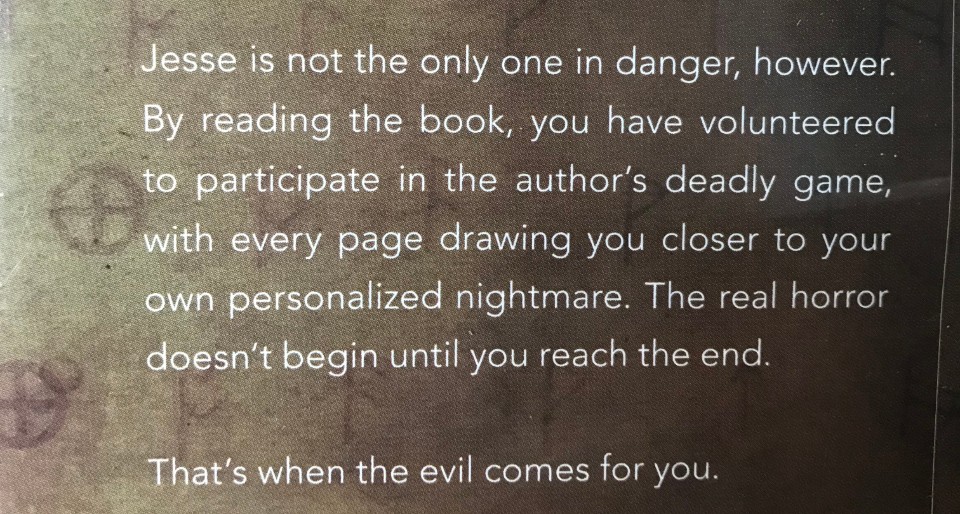
You know how in a lot of horror movies, there’s the one skeptic who doesn’t believe in the supernatural, so they taunt it, only to be the one killed in the most gruesome way? The Will Haunt You book jacket makes readers not want to tempt this potentially supernatural book. (See photo.)

Will Haunt You tells the story of former musician Jesse Wheeler. Years ago, Jesse came home drunk after a gig, and his son suffered a serious, life-altering injury while Jesse should have been watching him. That event was a wake-up call, and Jesse has been sober for years.

Jesse performs with his band after a long hiatus and manages to stay sober, despite pressure from his bandmates. He acts as designated driver for one of his bandmates, but what should have been an ordinary drive became something much more sinister.

A weird radio station he’s listening to on the drive seems to know exactly what Jesse is up to, and the car clock is stuck on midnight for what feels like ages. His car stalls and two cops appear. But something feels off…it quickly becomes clear that the cops are not there to help.

This begins Jesse’s haunting. He ends up in what initially looks like a hospital but is quickly revealed to be his own unique personal hell. He is forced to confront his demons, and just when he thinks things cannot get worse, they do. Someone knows his secrets and is using them to terrify him.

All of this is happening to Jesse because he read Will Haunt You, and anyone who reads the book becomes a part of the book’s sinister plans. Brian Kirk tells Jesse’s story of being tortured and manipulated by evil masterminds, and Kirk warns the reader that a similar fate awaits us if we continue reading. At the beginning of the book, Kirk effectively creeps out the reader by telling us that we’re next and there’s no way out.

But it’s Kirk’s promises that we’d be haunted that led the book to fall flat. The scariest element of the book is that we are next, but much of the book didn’t reference that. It’s a risky choice to break the fourth wall, but if an author’s going to do it, it needs to really draw the reader in and make an essential element of the book. It felt like it was randomly peppered in throughout the book to scare readers. The book focused mostly on what was happening to Jesse, and it felt like the fourth wall broke when Jesse’s torture got a little mundane.

Kirk does a fantastic job building suspense, but often, nothing happens with that feeling. After something bad happened, Jesse would allude to things getting much worse than they just were, which is a fantastic way to pique readers’ interest, but the worse thing was often a letdown, and I found myself left with excitement that had nowhere to go.

While this book definitely has elements that are creepy, more needed to be done to pull the reader in and make the book more immersive. The reader involvement needs to feel more engrained within the book rather than being used as a crutch to make the book feel scarier.

The Tenth Girl

Rating: 2.5/5 ghosts

Photo of the cover of The Tenth Girl

What makes horror so compelling? Is it the adrenaline rush you feel after a big scare? Is it the distraction it provides from the horrors of real life? I think Sara Faring, author of The Tenth Girl, effectively describes why I’m so drawn to horror:

But isn’t it kind of beautiful to experience primal fear? To feel your pulse quicken because a pile of well-laid stones catch shadows and carry sound in unusual ways? How often are we so bored and anesthetized by our routines—in our safe surroundings—that we lose all sense of what’s magical about our existence? (p. 48)

The Tenth Girl is told through the perspective of two characters: Mavi and Angel. In 1978, Mavi begins teaching at the Vaccaro School, a creepy, remote school in Argentina. This school, which just reopened after years of being closed, is surrounded by tragedy and horror. There are whisperings of a Zapuche curse on the house and rumors about what happened to the last students who attended the school. Angel, who is from the year 2020, is able to (seemingly) travel through time and visits the school as a spirit.

Not long after the school year starts, things become weird. Mavi has nine students and knows a tenth should be coming, but any mention of this tenth girl is shut down. One by one, the girls become ill, and Mavi’s fellow teachers begin acting strangely. Angel befriends Mavi, and the two work to determine what is happening at the Vaccaro school.

Is the house haunted? Is it a generations-old Zapuche curse? (Sidenote: This book was published in 2019. Can we stop using the annoying trope of indigenous peoples’ curses/sacrificing innocent people? It’s tired and offensive and boring.) Or is the house innocent and do evil people live in the house?

The beginning (actually the first ¾ of the book) tell an interesting and haunting story about moral relativism, loss, and the love of a mother. Had the book just told that story, I probably would have rated it higher. The ultimate issue with The Tenth Girl is the “twist you’ll never see coming” (as advertised on the back cover of the book). The twist cheapens the creepiness and compelling plot of the first part of the book, and it feels like Faring wanted to get out of wrapping up the compelling and complex story she initially set up. Perhaps the twist was too ambitious, but even the most skilled writer would not have been able to make the surprise ending not feel cheap.

Faring is clearly a talented writer, and I think she has more horror books within her. But this book tried to do too much. It made readers invested in an interesting and heartfelt story, only to conclude the book by essentially telling readers to forget that old story and get into this new plot.

(If you do not want to read any spoilers, stop reading here. Continue if you want to know more about why the twist was such a letdown. This was a very hard review to write without giving away anything.)

SPOILERS BELOW. READ AT YOUR OWN RISK.

The big twist is essentially the plot of Westworld. The reason Westworld is so compelling is because of the dramatic irony. We become invested in the town and the robots because that’s ultimately the story we’re following. In contrast, The Tenth Girl spends hundreds of pages telling one story and then concludes the book by telling another. It felt like the equivalent of a character waking up and realizing all the terrible things that happened were a dream.

About Haunting of Lit House Reviews

The Haunting of Lit House aims to provide entertaining and informative reviews that can help you decide if you want to read a book. I do my best to avoid spoilers, but if I must include them, I will note them and tell you when to stop scrolling if you’d like to avoid the spoiler.

This blog focuses on horror, and I know that what’s scary to one person isn’t scary to another. As a result, I will never penalize a book for not being scary. And though this post uses first person like it’s going out of style, my book reviews don’t. I hate book reviews where the reviewer says, “I didn’t like the main character” without explaining why. Show; don’t tell.

I rate books on a scale of 1-5, with 5 being the best. Rather than using boring stars, I vary the unit based on the book, e.g., Dracula may be rated on a scale of 1-5 vampires. I will occasionally use decimals in ratings. Here’s a breakdown of what each number means:

  • 5: Very few (basically no) books will receive a 5. The Shining is a 5. To earn a 5, a book needs to be beautifully written, scare the crap out of me, and pull at the heartstrings. If a book earns a 5, the review will contain a paragraph explaining what made it so outstanding that it earned a 5.
  • 4: Amazing books will earn a 4. To earn a 4, books must be well written and (of course) scary. Books that fall into this category are well worth checking out.
  • 3: Most books will earn a 3. Think of this as a job evaluation. If you’re good at your job and do everything well, you earn the middle “meeting expectations” rating. You have to truly go above and beyond and revolutionize something to earn more than that. A book that earns a 3 is a great book. It’s compelling and worth reading, but does not exceed my expectations.
  • 2: A book with some flaws will earn a 2. These flaws may include the writing style, plot holes, or pacing issues. I will do my best to point out specific parts of the book that I found problematic.
  • 1: To earn a 1, a book has to be offensive or (in my mind) have no intended audience. I have yet to read a horror novel that I would rate a 1.

It’s important for me to mention that there are some books that I read with the intention of writing a review but couldn’t. This is because they weren’t particularly memorable or I just don’t have much to say about them. Most of them are 3s. If you would like to see a list of those books with a rating (but no detailed review) let me know.

A note to authors: If I gave your book a poor rating, please don’t take it to heart! You are a great writer, and a lot of people would love your writing. I’m just one idiot with a laptop and an opinion. I don’t even like Oreos, so that should tell you something about my character. If I gave your book a good rating, take it to heart! You’re amazing and I want to read more from you.